5 Times Table Multiplication Dice Game: Turning Fluency Practice into Play
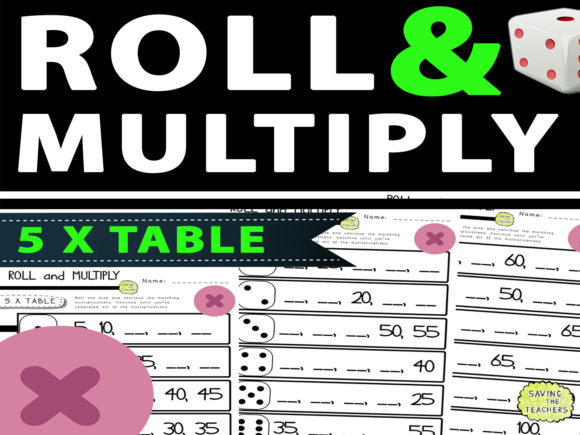
The 5 Times Table Multiplication Dice Game is a deceptively simple educational tool designed to bridge the gap between rote memorization and genuine number sense. At its core, this resource transforms the often-dreaded task of multiplication recall into an interactive, tactile experience. Students roll a standard die and complete the corresponding multiplication facts on a dedicated activity sheet, continuing until the grid is filled. However, viewing this merely as a worksheet alternative misses its broader utility. For educators, homeschoolers, and tutors, this game serves as a versatile mechanism for building automaticity in the five-times table without triggering the math anxiety that often accompanies timed drills or flashcards.
Morning Work and Transition Management
One of the most immediate real-world applications for this dice game is within the chaotic first fifteen minutes of the school day. Morning work needs to be self-directed, engaging enough to settle energy, but structured enough to reinforce learning. Traditional worksheets can feel punitive before the day has even begun, while unstructured free play can make transitioning to formal instruction difficult. The 5 Times Table Multiplication Dice Game occupies a perfect middle ground. The physical act of rolling the dice provides sensory feedback that helps regulate student focus, while the clear endpoint—completing the sheet—offers a tangible goal.
Because the activity is self-paced, it naturally accommodates staggered arrival times. Early arrivals can begin immediately without waiting for instructions, while latecomers can integrate seamlessly without disrupting the flow. Teachers have observed that this type of gamified entry routine reduces behavioral friction during transitions. The students are technically practicing math, but their cognitive load is focused on the mechanics of the game rather than the pressure of performance, making it an ideal soft start to academic rigor.
Differentiation in Mixed-Ability Settings
A significant challenge in any numeracy block is addressing the wide variance in fluency levels. This resource includes five differentiated activity sheets, which is where its practical value shines in inclusive classrooms. Differentiation here isn't just about changing the numbers; it is about altering the cognitive demand and scaffolding required to access the curriculum.
- Emerging Learners: Lower-level sheets may include visual arrays or number lines alongside the equations, allowing students to verify answers physically rather than relying solely on memory.
- Developing Fluency: Mid-tier sheets typically present standard equations with randomized ordering to prevent pattern reliance.
- Advanced Application: Higher-level sheets might introduce missing factors (e.g., 5 x __ = 35) or inverse division problems disguised within the multiplication framework.
In a practical setting, this allows a teacher to assign specific sheets based on formative assessment data without visibly singling out students. Since everyone is playing the same "game" with dice, the social stigma often associated with remedial work is eliminated. A student working on basic 5x1 through 5x5 facts sits beside a peer tackling 12x5 and beyond, both engaged in the identical mechanical process. This equity in engagement is crucial for maintaining classroom culture while ensuring individual growth.
Intervention and Tutoring Scenarios
Beyond the general education classroom, this dice game proves invaluable in targeted intervention settings, such as RTI (Response to Intervention) blocks or private tutoring sessions. When working one-on-one or in small groups, rapport and low-stakes practice are paramount. Tutors often find that direct drilling causes shutdowns in students who have experienced repeated failure with multiplication tables. The dice introduce an element of chance that externalizes the difficulty. If a student struggles with a fact, it feels like a result of the roll rather than a personal failing.
Furthermore, the game facilitates metacognitive conversations. Because the pace is slower than a digital app or a timed test, there is space for the adult to ask, "How did you figure that out?" or "What strategy could we use if you forget 7 x 5?" The dice game becomes a diagnostic conversation starter rather than just an assessment tool. For parents supporting learning at home, this format removes the adversarial dynamic that can develop around homework. It shifts the parent's role from enforcer to co-player, preserving the relationship while reinforcing essential skills.
Gamification and Competitive Dynamics
While the base activity is solitary, the suggestion to add a competitive layer by timing completion opens up different pedagogical possibilities. However, applying competition requires careful consideration of the audience. For students with high math confidence, racing against a clock or a peer can induce a state of flow and accelerate processing speed. In these cases, the 5 Times Table Multiplication Dice Game acts as a fluency accelerator.
Conversely, for anxious learners, introducing a timer can be counterproductive. In these scenarios, the competition should be reframed as personal best tracking rather than peer comparison. Having students record their time on a private chart allows them to compete against their own previous performance, celebrating incremental progress. Educators have also found success in cooperative variations, where pairs share one die and one sheet, taking turns rolling and solving. This promotes mathematical discourse and peer teaching, turning the activity into a collaborative problem-solving exercise rather than a race.
Practical Considerations Before Implementation
Before integrating this resource into a rotation or lesson plan, several logistical factors warrant attention. First, consider the physical environment. Dice are noisy. If using this in a quiet testing zone or a shared library space, foam dice or designated rolling trays are necessary modifications to manage auditory distractions. Second, ensure students have mastered the *concept* of multiplication by fives before using this for *fluency*. This game reinforces recall; it does not teach the underlying concept of equal groups or skip counting. Using it prematurely can lead to frustration or the reinforcement of incorrect guessing strategies.
Durability is another practical concern. Activity sheets used repeatedly in centers will degrade quickly. Laminating the sheets and providing dry-erase markers extends the lifespan of the resource significantly and reduces paper waste. Alternatively, placing the sheets inside plastic page protectors achieves the same effect with less environmental impact. Finally, always have a backup plan for lost dice. Keeping a few spare dice in the center bin prevents the activity from stalling due to minor equipment failures.
Strengths and Limitations in Context
The primary strength of the 5 Times Table Multiplication Dice Game lies in its multisensory approach. Kinesthetic learners benefit from the manipulation of the die, visual learners engage with the structured layout, and the repetitive nature supports memory consolidation through spaced practice within a single session. It is also highly portable and requires zero technology, making it resilient to internet outages or device charging issues.
However, users should recognize its limitations. Random dice rolls mean that some facts may appear frequently while others are neglected in a single session. This randomness is excellent for preventing rote patterning but poor for systematic coverage. Teachers should view this as a supplementary reinforcement tool rather than a comprehensive instructional sequence. Additionally, because it focuses exclusively on the five-times table, it must be part of a broader numeracy ecosystem that connects these facts to other operations and real-world contexts. Used in isolation, it builds isolated fluency; used strategically, it builds confident mathematical thinkers.