Build a Jack-O-Lantern Halloween Game: An Interactive Learning Activity
Halloween is often associated with candy and costumes, but for toddlers and preschoolers, it also presents a unique window for developmental play. The Build a Jack-O-Lantern Halloween Game transforms seasonal excitement into a structured educational opportunity. This digital download is more than just a craft; it is a comprehensive activity set designed to bridge the gap between festive fun and foundational learning. By engaging children in creating their own pumpkin faces, caregivers can introduce concepts of geometry, pattern recognition, and fine motor skills in a context that feels like play rather than instruction.
For parents, educators, and therapists seeking age-appropriate seasonal activities, understanding the utility of this resource is essential. It offers a versatile platform for learning that adapts to various skill levels, from simple shape matching for two-year-olds to independent creative design for early elementary students. This article explores the practical applications, educational value, and setup considerations for integrating this interactive game into your Halloween rotation.
Educational Value Beyond the Holiday Theme
While the aesthetic is undeniably Halloween-themed, the core mechanics of the Build a Jack-O-Lantern Halloween Game are rooted in early childhood development standards. The activity serves as a tactile method for teaching abstract concepts. When a child selects a triangular nose or a circular eye, they are not merely decorating; they are engaging in geometric discrimination. This hands-on manipulation reinforces vocabulary and visual processing skills far more effectively than passive worksheet completion.
Shape Recognition and Spatial Awareness
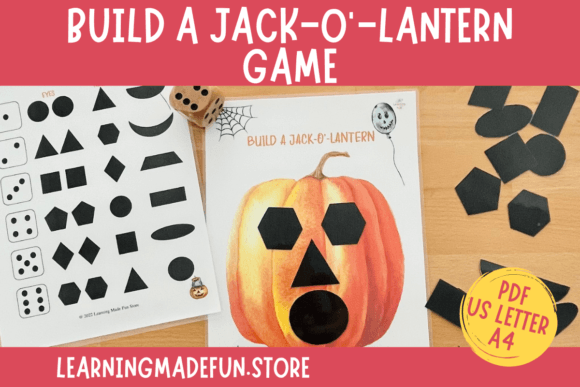
The included three sheets of shapes provide varied options for eyes, mouths, and noses. This variety is intentional. Children must evaluate which shape fits their vision or matches a specific pattern card. This decision-making process builds spatial awareness. They learn to rotate pieces, compare sizes, and understand how individual parts contribute to a whole face. For toddlers, simply distinguishing between a square and a circle within the context of a pumpkin face solidifies these basic math concepts through emotional engagement and seasonal relevance.
Patterning and Cognitive Flexibility
The 20 included pattern cards serve as scaffolding for cognitive development. Following a pre-set design requires a child to observe, retain visual information, and replicate it using physical pieces. This is an exercise in working memory and attention to detail. However, the true value emerges when children move beyond the cards. Creating their own faces encourages divergent thinking and emotional expression. A jagged mouth might represent "scary," while a curved line represents "happy." This links social-emotional learning with artistic creation, allowing children to explore feelings in a safe, controlled environment.
Component Breakdown and Practical Setup
To maximize the longevity and usability of this digital download, proper preparation is key. The resource includes 11 pages total, formatted for both US Letter (8.5 x 11 in) and A4/A3 sizes. Understanding what is included helps users plan their printing and assembly strategy effectively.
- 1 Pumpkin Mat: The central workspace. This acts as the base for all construction and can double as a play dough mat for sensory integration.
- 20 Pattern Cards: Visual guides ranging from simple to complex, providing structure for learners who need explicit direction.
- 2 Roll the Dice Sheets: These add an element of chance and turn-taking, making the activity suitable for small groups or sibling play.
- 3 Sheets of Shapes: Cut-outs for facial features. Having multiple sheets allows for simultaneous play or replacement of lost pieces.
Durability and Reusability Strategies
Because this is a digital download, the physical quality depends entirely on how you prepare it. Laminating the pages is strongly recommended. Without lamination, paper pieces will tear quickly during enthusiastic toddler play. Lamination transforms the kit into a reusable classroom or home center staple. For attaching the removable pieces, Velcro dots are superior to glue or tape. They provide satisfying tactile feedback when pressed and allow for endless rearrangement without damaging the mat. Alternatively, if using the mat for dry erase marker tasks, lamination is mandatory to prevent permanent staining.
Versatile Applications Across Environments
The adaptability of the Build a Jack-O-Lantern Halloween Game makes it suitable for diverse settings. Its low-prep nature after initial assembly means it can be deployed quickly in moments where engagement is needed.
Home Learning and Rainy Day Play
For parents, this kit solves the problem of screen-free seasonal entertainment. It is compact enough to store in a binder and pull out during rainy October afternoons. The dual function of the mat as a play dough surface extends the activity's lifespan. If a child loses interest in placing paper shapes, switching to molding clay pumpkins on the same mat maintains the thematic connection while shifting the sensory input. This flexibility is crucial for maintaining toddler engagement over extended periods.
Classroom Centers and Therapy Sessions
Educators and occupational therapists will find specific utility in the structured components. The roll-the-dice sheets facilitate social skills practice, requiring children to wait for turns and follow game rules. In therapy settings, the act of picking up small shape pieces supports pincer grasp development. The pattern cards can be differentiated easily; a therapist might use only matching cards for a child working on basic correspondence, while offering blank creation prompts for a child practicing executive function and planning. The ability to print multiple copies ensures that entire small groups can participate simultaneously without conflict.
Evaluating Suitability and Managing Expectations
Before downloading and assembling, it is helpful to assess whether this resource aligns with your specific needs. While highly versatile, no single activity is perfect for every scenario.
Age Appropriateness and Skill Level
This game is optimized for ages 2 to 6. Toddlers will benefit most from the tactile aspect and basic shape naming, though they may require adult assistance with Velcro alignment. Preschoolers and kindergarteners can utilize the pattern cards and dice independently. Users should note that children under two may find the small pieces frustrating or potentially hazardous if not supervised closely. Conversely, older children might find the basic shape placement too simple unless challenged to create complex, symmetrical designs or write descriptive words about their pumpkins using dry erase markers.
Preparation Time vs. Play Value
As a digital product, there is an upfront time investment. Printing, cutting, laminating, and applying Velcro to dozens of small pieces can take several hours. Users must weigh this preparation time against the intended frequency of use. If this is for a single afternoon of play, the ROI may be low. However, for those who plan to use it annually, across multiple children, or in a professional setting where durability matters, the initial effort pays significant dividends. The reusability factor is the primary value proposition here; treating it as a disposable craft undermines its design intent.
Sensory Considerations
While beneficial for many, some neurodivergent children may have strong reactions to specific textures. The sound of Velcro ripping or the smell of fresh laminate can be overwhelming for sensory-sensitive individuals. Caregivers know their children best; consider testing these elements before full implementation. Fortunately, because the pieces are loose, alternatives like magnetic strips or simply resting pieces on the mat without adhesive can accommodate different sensory profiles while retaining the educational core.
Maximizing the Interactive Experience
To get the most out of the Build a Jack-O-Lantern Halloween Game, facilitators should view it as a conversation starter rather than a silent task. Ask open-ended questions during play. Instead of saying "Put the triangle nose on," try asking, "Which shape looks spooky for a nose?" or "Can you make a surprised face?" This verbal interaction amplifies language development.
Additionally, consider integrating literacy. Use the dry erase capability to have children label their pumpkin’s emotions or count the number of teeth they added. For advanced learners, introduce symmetry challenges by drawing a line down the center of the mat and asking them to mirror the left side on the right. These extensions transform a simple matching game into a multidisciplinary lesson covering math, language, art, and social-emotional growth.
Ultimately, this printable resource succeeds because it respects the intelligence and capability of young learners. It provides structure without stifling creativity, and festivity without sacrificing education. Whether used in a bustling classroom center or at a quiet kitchen table, it offers a meaningful way to celebrate the season while building essential skills that last long after the jack-o-lanterns have faded.