Evaluating the Football Video Game Color Line Icon for Professional Design Workflows
In the competitive landscape of digital asset creation, finding vector graphics that balance specific thematic relevance with technical flexibility is a persistent challenge for designers and content creators. The Football Video Game Color Line Icon represents a specialized intersection of sports aesthetics and retro-digital nostalgia that serves a distinct niche. Unlike generic sports clip art or complex 3D renders, this asset type focuses on the stylized representation of football through the lens of video game culture. For professionals managing projects that bridge athletic content with gaming interfaces, understanding the practical utility, technical specifications, and application limits of this editable stroke linear icon is essential for maintaining workflow efficiency and visual consistency.
Defining the Asset: Technical Specifications and Visual Language
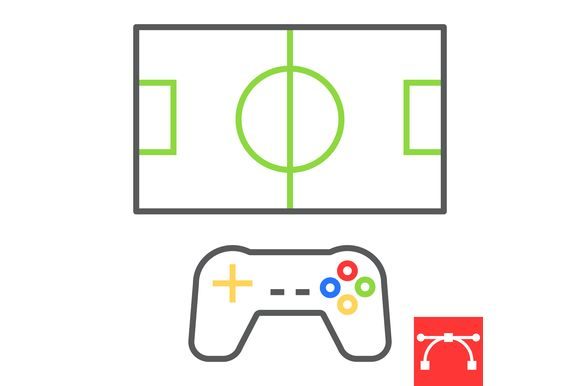
The core value of the Football Video Game Color Line Icon lies in its hybrid visual identity. It typically combines the geometric structure of a football field sign or ball with the pixelated or neon-linear aesthetics associated with arcade cabinets and console interfaces. When sourced as an EPS 10 file, the asset adheres to a widely compatible vector standard that ensures functionality across both legacy software and modern design suites. This format preserves the mathematical precision of the lines, allowing for infinite scaling without the artifacting common in raster-based gaming assets.
Critical to its professional utility is the "editable stroke" attribute. In many stock vectors, line work is expanded into shapes, making weight adjustments destructive and tedious. An editable stroke linear icon allows designers to modify the stroke width, cap style, and join properties directly within the appearance panel. This feature is particularly valuable when adapting the football video game color line icon for different media densities. A stroke weight that reads clearly on a desktop website header may appear too heavy on a mobile app interface or too thin on a large-format banner. Retaining stroke editability eliminates the need to source multiple variations or manually redraw paths, significantly reducing production time.
Practical Applications in Digital and Print Media
The versatility of this asset extends beyond simple decoration. Its specific stylistic blend makes it highly effective for several professional use cases where tone and clarity must coexist.
- User Interface (UI) Design: For fantasy football platforms, sports betting applications, or gaming review sites, this icon functions as an intuitive navigational anchor. The color line style provides sufficient contrast against dark mode backgrounds common in gaming UIs while maintaining the semantic recognition of football.
- Editorial and Blogging: Content creators covering e-sports or the intersection of traditional sports and simulation games can use the icon to break up text-heavy articles. It serves as a visual cue that signals the content’s specific angle, distinguishing it from general sports reporting.
- Merchandise and Apparel: The vector nature of the EPS 10 format makes it ideal for screen printing and embroidery digitizing. The clean lines translate well to fabric, and the color separation inherent in line icons simplifies the printing process compared to full-color raster illustrations.
- Presentation and Pitch Decks: Marketers proposing gaming-related sponsorships or sports-tech products can utilize the icon to reinforce brand themes without resorting to copyrighted screenshots from actual video games, thereby mitigating intellectual property risks.
Assessing Quality and Workflow Integration
When evaluating the Football Video Game Color Line Icon for integration into a professional library, several quality indicators determine its long-term value. The primary consideration is path cleanliness. High-quality vector assets should exhibit minimal anchor points and smooth bezier curves. Jagged edges or unnecessary nodes in an EPS 10 file can cause rendering issues when exported to SVG for web use or when processed by CNC machines for physical production. Professionals should inspect the file at high zoom levels before licensing to ensure the geometry supports rigorous editing.
Color management is another critical factor. While described as a "color line" icon, the best assets utilize global swatches or clearly organized layer structures. This allows for rapid rebranding. If a project requires shifting from a generic arcade palette to specific team colors or corporate brand guidelines, the ability to select all strokes and apply a new color profile instantly is a significant efficiency multiplier. Assets that rely on hardcoded RGB values buried within grouped objects create friction and increase the likelihood of color inconsistency across deliverables.
Furthermore, the conceptual execution matters. The most effective versions of this icon avoid being overly literal. A successful football video game color line icon captures the *feeling* of gameplay through abstraction rather than attempting to replicate a specific console's proprietary artwork. This abstraction not only enhances design flexibility but also future-proofs the asset against obsolescence as hardware generations change. Timeless design principles applied to niche themes ensure the graphic remains relevant even as specific gaming trends evolve.
Audience Fit and Strategic Considerations
While broadly useful, this asset type offers disproportionate value to specific segments of the creative workforce. Freelancers and agency designers working on tight deadlines benefit most from the editable stroke feature, as it allows for rapid iteration during client feedback cycles. Educators and instructional designers creating gamified learning modules for sports management or physical education courses will find the icon’s approachable, non-aggressive aesthetic suitable for academic environments where hyper-realistic violence or commercial branding is inappropriate.
Small business owners in the sports memorabilia or gaming lounge sectors can leverage these vector graphics to establish a cohesive visual identity without the expense of custom illustration. The EPS 10 compatibility ensures that a single purchase can service business cards, signage, social media templates, and merchandise, maximizing return on investment. However, enterprise-level brands with strict design systems should exercise caution. While the icon is customizable, it still carries a distinct stylistic signature. It must be evaluated against existing brand guidelines to ensure it does not introduce visual dissonance or clash with established typographic and illustrative standards.
Limitations and Best Practices for Implementation
Despite its strengths, the Football Video Game Color Line Icon has inherent limitations that professionals must navigate. The linear style, while clean, lacks the texture and depth required for hero images or immersive background elements. It is fundamentally a supporting graphic element. Attempting to scale it to fill massive negative space without additional design treatment can result in a sparse or unfinished appearance. Pairing the icon with complementary textures, gradients, or typography is often necessary to achieve visual balance in larger compositions.
Licensing and originality also require due diligence. Because "football video game" is a popular search term, marketplaces are saturated with similar assets. To maintain a unique brand presence, users should avoid using the icon in its default state. Utilizing the editable stroke to alter dash patterns, combining multiple icons into a composite pattern, or integrating the vector paths into more complex custom illustrations helps differentiate the final output. Additionally, verifying the license terms regarding trademarked likenesses is crucial; while the icon itself may be original, any incidental resemblance to protected franchise logos could pose legal risks in commercial contexts.
Technical compatibility, while generally strong with EPS 10, warrants verification in specific workflows. Users operating exclusively in browser-based design tools or older versions of vector software should test the file immediately upon acquisition. Some EPS 10 files contain transparency effects or gradient meshes that do not translate perfectly between disparate applications. Establishing a standardized import protocol—such as converting to native formats or outlining strokes for archival purposes—can prevent downstream production errors.
Making the Final Determination
The decision to incorporate a Football Video Game Color Line Icon into a project should be driven by functional necessity rather than novelty. When the objective is to communicate a fusion of athletics and digital entertainment with clarity, scalability, and editability, this asset class performs reliably. Its strength is not in artistic complexity but in its utility as a modular design component. For professionals who prioritize workflow efficiency and technical adaptability, the editable stroke linear icon in EPS 10 format represents a pragmatic solution to a specific visual communication problem. By understanding its technical parameters, respecting its stylistic boundaries, and applying thoughtful customization, creators can extract significant value from this specialized graphic resource while maintaining the professional standards expected in commercial design.