Multiplayer Game Color Line Icon: Enhancing UI Design with Editable Vector Graphics
In the rapidly evolving landscape of digital entertainment, visual communication is just as critical as gameplay mechanics. For designers, developers, and content creators working within the gaming sector, finding assets that are both aesthetically pleasing and technically flexible is a constant priority. The Multiplayer Game Color Line Icon represents a specific category of vector graphics designed to bridge the gap between artistic expression and functional user interface design. Unlike rasterized images that lose quality when resized, these icons utilize editable stroke linear paths, typically delivered in EPS 10 format, allowing for infinite scalability and customization without compromising visual integrity.
This type of asset is not merely a decorative element; it is a fundamental building block for modern game UI/UX. Whether you are designing a lobby screen for a competitive shooter, creating promotional material for an esports tournament, or building a dashboard for a game streaming platform, the Multiplayer Game Color Line Icon provides the semantic clarity needed to guide users through complex digital environments. Understanding how to leverage these resources effectively can significantly reduce production time while elevating the professional polish of your final product.
Addressing Common Design Challenges in Gaming Interfaces
Professionals in the gaming industry face a unique set of challenges when sourcing or creating iconography. The primary issue is often versatility. A static image might look perfect on a 1080p monitor but appear pixelated on a 4K display or blurry on a mobile device. Furthermore, gaming aesthetics vary wildly; a neon cyberpunk style requires different line weights and color palettes than a retro pixel-art platformer. Sourcing separate icon packs for every project variation is cost-prohibitive and creates workflow inefficiencies.
Another significant hurdle is consistency. When combining assets from multiple sources, discrepancies in stroke width, corner radius, and optical balance become immediately apparent to the user. This visual dissonance can subconsciously signal a lack of quality or professionalism. The Multiplayer Game Color Line Icon solves this by offering a unified design language. Because these are vector-based assets with editable strokes, designers can globally adjust parameters to match their specific brand guidelines. If your interface requires a 2px stroke instead of the default 3px, or if you need to shift from rounded caps to square ends, these changes can be made instantly across the entire library rather than redrawing each symbol individually.
The Technical Advantage of EPS 10 and Editable Strokes
The specification of EPS 10 is deliberate and highly relevant for professional workflows. While newer formats exist, EPS 10 remains a universal standard compatible with virtually all vector editing software, including Adobe Illustrator, CorelDRAW, Affinity Designer, and open-source alternatives like Inkscape. This compatibility ensures that teams using different toolsets can collaborate without file corruption or loss of editability.
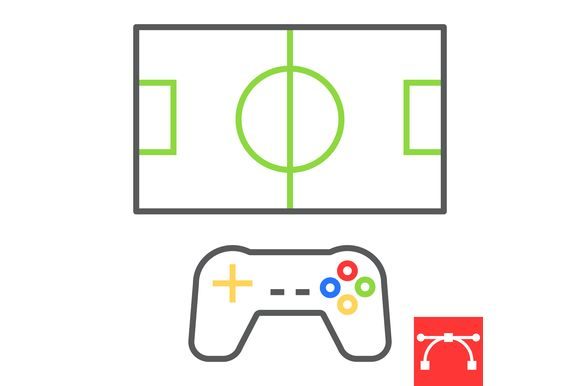
The "editable stroke" feature is perhaps the most valuable technical aspect of these icons. In many vector libraries, shapes are expanded into filled outlines, making them difficult to modify. An editable stroke retains the mathematical path data, meaning the line itself remains a live object. This allows for non-destructive editing. You can change the color, thickness, dash pattern, and cap style at any point in the design process. For a Multiplayer Game Color Line Icon depicting a gamepad or console sign, this means you can easily adapt the icon to serve as a subtle background watermark at 10% opacity and thin weight, or as a bold, high-contrast call-to-action button, all from the same source file.
Practical Applications Across Different User Roles
Different stakeholders in the gaming ecosystem utilize these assets to achieve distinct outcomes. Recognizing these varied use cases helps in selecting the right assets and implementing them effectively.
- UI/UX Designers: For interface architects, these icons serve as navigational anchors. A clearly defined multiplayer icon helps users instantly recognize matchmaking menus, friend lists, or party chat functions. The ability to customize colors allows designers to maintain accessibility standards, ensuring sufficient contrast ratios against dynamic game backgrounds.
- Game Developers: Indie developers and small studios often lack dedicated art teams. Using a cohesive Multiplayer Game Color Line Icon pack allows programmers to implement professional-grade UI without hiring a full-time illustrator. The vector nature means these assets integrate seamlessly into engines like Unity or Unreal Engine, supporting resolution-independent rendering.
- Content Creators and Streamers: Overlay design is crucial for audience retention. Streamers use these icons to label controller inputs, indicate team compositions, or highlight sponsor segments. The clean, linear aesthetic of these icons ensures they remain legible even when scaled down in a busy video overlay.
- Marketing Teams: Promotional materials require high-resolution assets for everything from social media thumbnails to large-format convention banners. Vector graphics ensure that the gamepad and console signage looks crisp regardless of the output medium, maintaining brand consistency across digital and print channels.
Implementation Best Practices and Considerations
To maximize the utility of a Multiplayer Game Color Line Icon, users should adopt a systematic approach to implementation. First, establish a global style guide before modifying individual assets. Define your standard stroke weight, corner radius, and color palette based on the target platform and viewing distance. Mobile interfaces generally require thicker strokes and simpler details compared to desktop applications where users sit closer to the screen.
Color management is another critical consideration. While these icons are marketed as "color line" assets, relying solely on color to convey meaning can exclude users with color vision deficiencies. Always pair color coding with distinct shape variations or supplementary text labels. The editable nature of these vectors makes it easy to create monochrome variants for accessibility compliance or dark mode adaptations.
When integrating these icons into game engines or web frameworks, consider optimization. Although EPS 10 is excellent for editing, it is rarely used directly in production code. Export optimized SVGs for web and mobile apps, or generate texture atlases for game engines. Retain the original EPS files as your master source, but treat the exported formats as your delivery assets. This workflow preserves editability for future updates while ensuring runtime performance is not impacted by unnecessary vector complexity.
Selecting the Right Asset for Your Project Goals
Not all vector packs are created equal. When evaluating a Multiplayer Game Color Line Icon resource, look beyond the thumbnail preview. Inspect sample files to verify that strokes are truly editable and not expanded shapes. Check for consistent grid alignment; professional icons are snapped to a pixel grid to prevent anti-aliasing artifacts at common sizes. Review the license terms carefully, especially if you plan to embed the icons in a commercial game or sell templates derived from them.
Consider the semantic breadth of the collection. A robust pack should include not just generic gamepads, but specific console signs, keyboard/mouse indicators, and abstract multiplayer concepts like connectivity nodes or team badges. Having a comprehensive set reduces the likelihood of needing to draw custom icons later, which often leads to stylistic mismatches. The goal is to find a resource that feels like it was drawn specifically for your project, even though it is a pre-made asset.
Ultimately, the value of a Multiplayer Game Color Line Icon lies in its capacity to streamline the creative process while maintaining high visual standards. By leveraging the technical benefits of editable EPS 10 vectors, professionals can focus less on drawing basic symbols and more on crafting engaging user experiences. Whether you are building the next competitive esports title or designing a community hub for gamers, these versatile graphic elements provide the foundational visual language necessary to connect players with the content they love. Investing time in understanding and properly implementing these assets pays dividends in both efficiency and end-user satisfaction.